Luang Por Ding Khankasuwanno of Wat Bang Wua
Biography of Phra Kru Piboon Khanarak (Ding) of Wat Bang Wua

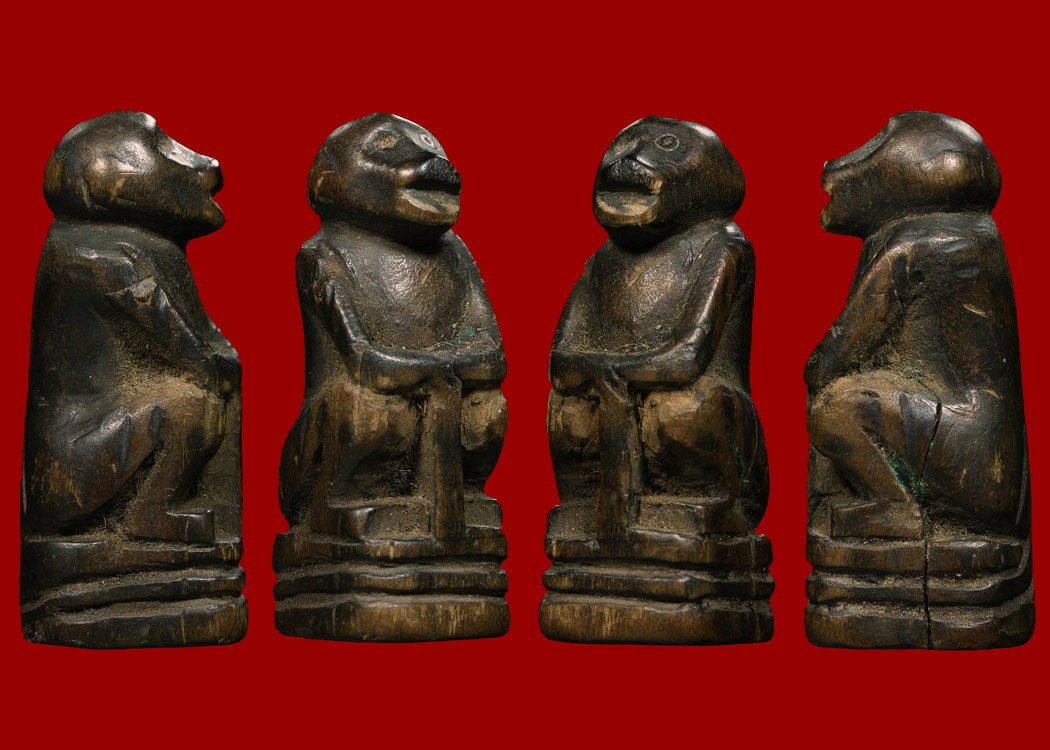
Luang Por Ding of Wat Bang Wua (also known as Wat Usapharam) in Chachoengsao province was one of the most renowned monks of the past. His sacred objects and amulets are highly sought after by Buddhist devotees and collectors of religious artifacts. Today, they are extremely rare and highly prized by those who possess them. Among his most notable creations are the “carved monkeys” made from the roots of the rak and pootsorn trees, renowned for their powerful spiritual properties.

Phra Kru Piboon Khanarak, commonly known as Luang Por Ding Khankasuwanno, was the former abbot of Wat Bang Wua, also known as Wat Usapharam, in Chachoengsao province. He was born in Bang Wua, Bang Pakong District, Chachoengsao, on March 14, 1877. When he reached the age of ordination in 1897, he was ordained as a Buddhist monk.

Luang Por Ding was ordained at Wat Bang Wua, with Phra Ajarn Dit from Wat Bang Samak as his preceptor, Phra Ajarn Chang from Wat Bang Samak as his ordination teacher, and Phra Ajarn Plod from Wat Bang Wua as his mentor. He was given the monastic name “Khankasuwanno,” which auspiciously means “one whose mind is cool and serene like a river, and strong like gold.” From that moment on, he remained in the monkhood until the end of his life, passing away in 1952.

According to records that Luang Por Ding shared with his close disciples, he spent only one rainy season at Wat Traimitr Withayaram. During that time, Phra Athikan Pia, the abbot of Wat Bang Wua, passed away. The monks and laypeople of the temple held a meeting and decided to invite Luang Por Ding to return and assume the position of abbot. Respecting the faith and devotion of the laypeople, he accepted the position and returned to Wat Bang Wua to serve as its abbot from then on.

In 1900, just three years after his ordination, Luang Por Ding became the abbot of Wat Bang Wua. Upon assuming this position, he began to develop and restore the various structures in the temple, which had been deteriorating over time. He also promoted the study of Buddhist scriptures (pariyatti dhamma) for monks and novices.

Luang Por Ding often shared with his close disciples that he had three main teachers who significantly influenced his learning:

  1. Luang Por Dit Brahmasaro of Wat Bang Samak, who was his preceptor.
  2. Luang Por Pern of Wat Ban Kao in Ban Kao Subdistrict, Phan Thong District, Chonburi Province. He was highly skilled and even reputed for subduing foreigners who came to spread Christianity to the point where they submitted to him. It was said that when foreigners fired guns at the ordination hall of Wat Ban Kao, the bullets did not go off.
  3. Luang Por Poe of Wat Chuan Khuen Khan (believed to be Wat Chuan or currently known as Wat Chuan Darong Ratchapolkhan) in Phra Pradaeng District, Samut Prakan Province. He was highly proficient in herbal medicine and traditional medicine.

Luang Por Ding was a monk who adhered strictly to monastic disciplines, possessed a compassionate heart, and was highly proficient in various fields, including incantations and Buddhist magic that he had studied from renowned masters of his time. These included Phra Ajarn Dit of Wat Bang Samak in Chachoengsao, Luang Por Pern of Wat Ban Kao in Chonburi, and Luang Por Poe (Luang Por Peah) of Wat Chuan Khuen Khan in Samut Prakan. He was highly respected, loved, and revered by Buddhist devotees and had numerous disciples.

His sacred objects were known for their powerful spiritual properties and were highly sought after by collectors. Apart from his “carved wooden monkeys,” his “first batch amulet coins from 1938” are also highly prized and sought after by collectors.

Today, his last prominent disciple, Luang Pu Foo Atipatto of Wat Bang Samak in Chachoengsao, continues his legacy. Luang Pu Foo is also a renowned monk in the eastern region, with numerous disciples and followers.
hanuman lp ding

Hanuman Amulets

Among the various sacred amulets, there is one type known as the “Carved Monkey” or “Carved Hanuman,” which is famously associated with only three renowned temples. These are the carved monkey amulet by Luang Por Ding of Wat Bang Wua in Chachoengsao, the carved Hanuman by Luang Por Sun of Wat Sala Khun in Nonthaburi, and the Ongkot by Luang Por Pan of Wat Bang Krasaub in Samut Prakan.

The sacred objects and amulets created by Phra Kru Piboon Khanarak, or Luang Por Ding, the former abbot of Wat Bang Wua, have been highly coveted by Buddhist devotees and collectors of religious artifacts, both in the past and present. They are considered rare and difficult to find today because their owners highly cherish them. Particularly notable is the “Carved Monkey” amulet, made from the roots of the love tree and the jasmine tree, which is believed to hold significant spiritual power.

Most people who possess the carved monkey amulet by Luang Por Ding also recite a special Hanuman mantra associated with him. They begin by chanting the “Namo” prayer three times, followed by the mantra: “Hanumana Nama Pata.” The method for using this mantra involves chanting according to the day of the week, for example, 10 times on Saturday, 6 times on Sunday, 15 times on Monday, 8 times on Tuesday, and so on.

When visiting a superior, the amulet should be dipped in sandalwood oil and used to mark the forehead. When visiting a lover, the amulet should be dipped in sandalwood oil and circled around the navel clockwise. For visiting a man, the amulet should be dipped in sandalwood oil and circled around the navel counterclockwise.

If you want to make everyone in a house fall asleep, the amulet should be enchanted with the mantra according to the day of the week and placed on the main pillar of the house. Everyone in the house will fall asleep under the influence of Hanuman.

To confuse an enemy, the amulet should be held in the mouth while chanting the mantra according to the day of the week. Blowing air out afterward will leave the enemy dazed and bewildered.

Luang Phor Kum – Wat Bhothi Plum, Angthong

Wat Bhothi-plum, formely known as Wat Pai-Tong, is an ancient temple built in the Ayudhaya period

Though this temple had been governed by several abbots, the abbot that the temple is associated with is Luang Phor Kum. He created many kinds of sacred amulets such as Prasomdej , Pra Nue-wan, Takrut and Bia Gae.

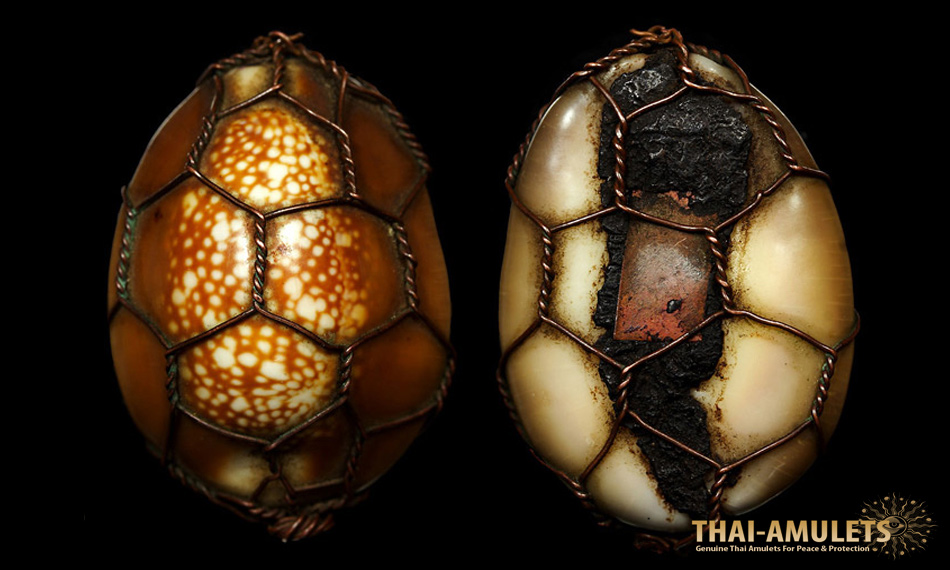
Luang Phor Kum began to create his Bia Gae amulets in B.E.2493, Generally his Bia Gae amulets appeared similar to those of Luang Phor Rod, except they were not covered with embroidered strings. Most disciples covered their own amulets to increase durability.

Luang Phor Kum also inserted his Takrud amulets onto his Bia Gae almost identically to Luang Phor Puck, the only difference being that his Takrut amulets were made of copper whilst those of Luang Phor Puck were made of lead.

Luang Phor Kum was born in B.E.2432 to the family of Mr. Seng and Mrs. Tai, locals off Angtong province.In B.E.2452, aged 20 he was ordained as a Buddhist monk at Wat Bhothi-plum and dedicated his life to help develop the temple and to create sacred amulets

At the age of 72 on June 25th, B.E.2503, he passed away having served Buddhism and Buddhists for 52 years


Luang Phor Iam – Wat Nang
หมากทุยหลวงปู่เอี่ยม วัดหนัง 

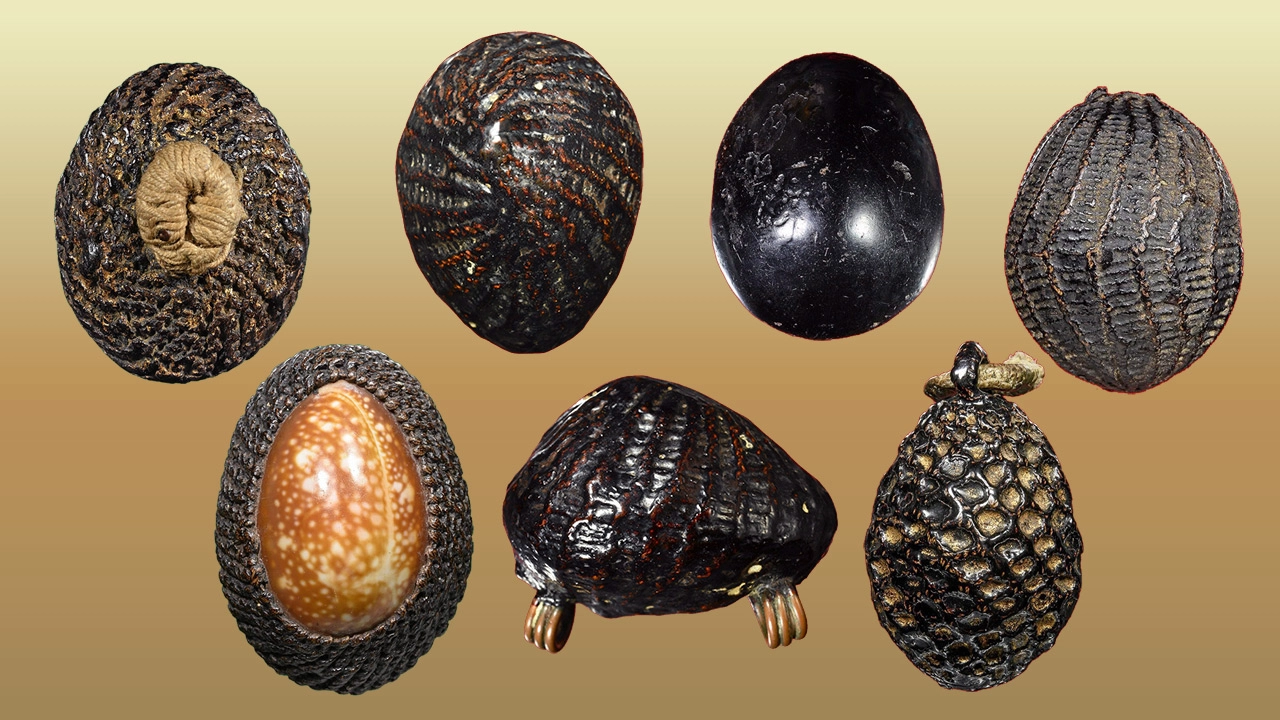
Luang Pu Iam of Wat Nang Ratchaworawihan in Bang Khun Thian, Chom Thong District, Bangkok, is a revered monk known for his exceptional spiritual powers. Initially a humble abbot, his reputation for creating powerful amulets reached the royal palace, attracting nobility and members of the royal family. Even King Chulalongkorn (Rama V) personally visited Wat Nang to pay respects to Luang Pu Iam. During a subsequent royal visit, the king bestowed upon him a luxurious robe and other gifts from France and conferred the royal title of “Phra Phawanakosol Thera” upon him.

One of Luang Pu Iam’s most renowned creations is the “Mak Tui” amulet, different from the Bia Gae amulets of Luang Poo Rod, because he did not use a sea shell for the basis of the amulet. The process of making these amulets was intricate and spiritually significant. It is said that he followed the ancient traditional methods first introduced during Ayudhaya period. First, disciples were instructed to climb an areca palm to harvest only the small, young areca nuts that had naturally withered. They were taught specific chants to recite continuously while climbing and harvesting. Using their mouths instead of hands, they would bite the nuts off the tree, maintaining the chant throughout.

Once collected, the nuts were hollowed out, and sacred relics or paper inscribed with the Buddha’s names were placed inside. After consecration, the hollowed areca nuts were sealed with a Thai sticky rubber called “Chanrong”, made from the nests of a Thai insect. “Chanrong” was chosen because he believed that it would protect the amulets for as long time. Luang Poo Iam’s Bia Gae amulets were popularly called “Mark Tui” because they were made from “Mak” or a kind of Thai fruit/ nut

The consecration process involved intense meditation and chanting, imbuing the amulets with spiritual energy. It was said that the nuts could stand up by themselves after the rituals, demonstrating their mystical power. Once consecrated, the nuts were wrapped in cord, coated with lacquer, and fitted with a loop for wearing around the neck. Given the sacred contents, it was deemed inappropriate to wear them on the waist or as keychains.

The Mak Tui amulet is believed to provide its bearer with invincibility, protection from harm, and immunity to weapons. Additionally, it safeguards against evil spirits. Owners are encouraged to regularly recite the chant “Namo Buddhaya” to maintain the amulet’s power.

The Mak Tui amulet is a testament to Luang Pu Iam’s profound spiritual abilities and the rich heritage of Thai Buddhist amulets. Its creation process and the powerful protection it offers make it highly valued by collectors and devout Buddhists alike.

bia Gae LP Iam

Luang Phor Rod of Wat Nai-Rong
เบี้ยแก้หลวงปู่รอดวัดนายโรง

Among the many revered amulets crafted by famous Buddhist monks in Thailand, each following their own unique ancient formulas, the “Bia Gae” amulets stand out for their remarkable spiritual power. Of these, the Bia Gae created by Luang Pu Rod of Wat Nai Rong, Thonburi, holds a special place of honor. It is considered one of the most renowned and highly respected in Thailand, earning a place in the prestigious “Benjapakee of Amulets”.

Luang Pu Rod, originally from Bang Phrom, Taling Chan district in Thonburi, was ordained at Wat Ngern, also known as Wat Ratchathitatharn, a temple renowned for its meditation practices. He later moved to Wat Nai Rong, where he eventually became the second abbot. His expertise in advanced meditation and his mastery in Buddhist incantations earned him great respect in the Bangkok Noi area. Contemporary to other revered monks like Somdet Phra Phutthachan (Toh Phromrangsi) and Luang Pu Iam of Wat Saphan Sung, Luang Pu Rod’s Bia Kae is especially esteemed.It is also known that he was a disciple of Luang Phor Khak who it is assumed that he learnt most of his knowledge from.

Luang Phor Khak, was highly specialized in ancient magic sciences and was attributed to have taught many other famous monks of that era including Luang Phor Boon of Wat Klang Bangkaew, Nakorn Pathom province and Luang Phor Ie of Wat Sattahip, Cholburi province.

His life was quite mysterious travelling from one place to another imparting knowledge to those that wanted to learn

Luang Pu Rod’s Bia Gae amulets are crafted from various sacred materials, including cowrie shells, mercury, and underground stingless bee resin. These materials were consecrated with ancient Khmer script and powerful incantations like the “16 Buddha Names” and the “Trinisinghe”. After these sacred rituals, the amulets were given to disciples for protection.

The unique characteristics of Luang Pu Rod’s Bia Gae make them easily identifiable. He meticulously selected shells of similar size, ensuring they had 32 teeth, symbolizing completeness. When shaken, these shells produce a soft clicking sound, indicating the presence of mercury inside. The underside of the shells is sealed with the resin.

Another distinctive feature is the meticulous cord wrapping around the amulet. This wrapping, often sealed with lacquer or persimmon gum, adds durability. The lacquer, over time, develops a blackish-red hue, indicative of its age. Some amulets are further adorned with gold leaf, whose aging process helps verify their authenticity. These amulets come in both hooped and non-hooped forms, with some containing hidden takruts (scrolls of incantations), making them exceptionally rare.

Comparing the Bia Gae from Wat Nai Rong with those from Wat Klang Bang Kaew reveals similarities in size and craftsmanship, possibly due to shared knowledge from the Nakhon Chai Si river region. However, differences can be noted in the cord-wrapping patterns, which vary between the two traditions.

In summary, the Bia Gae amulets of Luang Pu Rod are not only a testament to his spiritual prowess but also an enduring symbol of Thai cultural heritage. These amulets, with their unique blend of sacred materials and ancient rituals, continue to be highly sought after for their profound spiritual benefits.

LP Rod Bia Gae

Generally the design or style of the embroidered strings could be divided into two distinct types:

Type 1: Embroidered strings that covered the entire Bia Gae amulet.

Type 2: Embroidered strings that only partly covered the Bia Gae amulet. The centre of the front was not covered so that the shell amulet within was visible. 

Luang Phor Rod passed away in BE 2472.


History of Bia Gae amulets

The Thai Bia or cowry shell was an important form of legal tender during the Ayutthaya period. There was a lively trade in these white shells in South and Southeast Asia, being widely used as currency for small daily transactions. In fact cowry shells were still in circulation in the middle of the 19th century. Even today the financial term for interest is “”Daug Bia” literally translated, ”that which blossoms from a shell”.

Historically the cowry shell has been the symbol of wealth, and has been used as a currency, jewelry and as a religious object in almost every part of the world. In the realm of sympathetic magic the cowry is a powerful force, the shells representing the eyes of the gods and the womb of the goddess.

The Cowry was originally called the “concha veneer” – the shell of venus – by the ancients. The scientific name “Cypraea” came from Cyprus or Cyprian, the isle where the worship of Venus Aphrodite began. The women of Pompeii wore the Cowry to prevent sterility. The Aztecs associate the Cowry with pregnancy as do Japanese.

The Cowry is often used to represent the mouth of the Egyptian god Orisis. In Egyptian Mythology, the god Orisis “creates all living creatures by an infinite act of masturbation.”

The word cowry is derived from the Sanskrit Kauri, and is the same as Kali-Cunti, the Yoni (female genitalia) of the universe, the cowry shell represented the divine vulva and the idea of rebirth.

It was believed to have the power of conferring fertility and sexual potency. the vessel of life force and regeneration, the Cowry was the insurance of life’s continuance. It was the dwelling place for the Goddess who made fertile both woman and crops, and whose voice can be heard whispering in the sea shell her ancient wisdom.

The sacred sciences to create Bia Gae amulets can be dated to an ancient temple in Ayudhaya, “Wat Pradu Nai-Soengdharma” (400-500 years) and there is evidence to suggest that the practice is much older.

However, in the early days the designs and style varied considerably, that is until about 100 years ago when Luang Phor Rod of Wat Nai Rong designed the first Bia Gae amulet that has since become the prototype for all amulets since.

His design and that of his dsiciple Luang Phor Boon from Wat Klang Bang gaew was based on a very beautiful shiny tropical sea shell  with a humped back sometimes decorated with spots like a leopard skin, known as Bia Jun.

The very design of the shell with its  arched back was thought to deflect evil energy, but once filled with liquid mercury and blessed the shell talisman became immensely efficacous.  In fact Bia Gae amulets from this temple are famed throughout Thailand, and are widely believed to be an effective form of protection against all forms of evil.

Indeed is not uncommon for persons on their death bed to request such an amulet as protection from spirits that will endlessly disturb and torture the dying. It is said by some that such amulets will also help to set the soul free and give protection beyond the grave, ensuring a smooth passage into the next life.

The best known monks to create Bia Gae amulets are:


Luang Phor Rod, Wat Nai-Rong
Luang Phor Boon, Luang Phor Perm, Luang Phor Jeua – Wat Klang Bang Gaew
Luang Phor Iam – Wat Nang
Luang Phor Pak, Wat Bost, Angthong

Luang Phor Nuam, Wat Nangnai Angthong
Luang Phor Kum – Wat Bhoti Plum, Angthong

Four ways to hang Bia Gae amulets

Worshippers should hang Bia Gae amulets properly to optimize their sacred power:

Hang on the front of your breast when you need to encounter or face your enemies or protection from evil
Hang on the back of your breast when you want to flee from your enemies or other bad situations
Hang on the right side of your breast when you need to increase your charm.
Hang on the left side of your breast when you need to protect yourself from others’ weapons.

Important materials used in the creation of Bia Gae

Although Bia Gae amulets were created in various styles just as other types of Thai amulets, there are still four main materials usually associated with this kind of amulet:
2. Mercury. Although this substance was difficult to create there is an interesting account of how many monks obtained it. Apparently a rotten egg would be immersed in a polluted canal. Twenty four hours later, mercury could be extracted from the egg
3. Chamrong nest… A species of Thai insect similar in appearance to a bee but smaller. Excreta from these insects would be used to construct their nests. Very difficult to locate as they usually nest is deep forests.
4. Lead Plate & Red Cloth. Lead plate, inscribed with sacred spells would be used to cover the Bia Gae amulets prior to being bound in embroidered string. Red cloth similarly would be inscribed with sacred spells and was also popular.


(Note: Some creators of Bia Gae amulets often used copper, silver or bronze plates as an alternative to lead. It was assumed that the former three metals would attract wealth.