Bang Krathing and Its Historical Significance

Wat Bang Krathing is an ancient temple dating back to the Ayutthaya period, specifically during the reign of King Narai the Great. It was originally constructed under the leadership of Phraya Si Ratcha Decho Chai (Thip), a notable nobleman who, according to legend, escaped capture by the Burmese using mystical powers. However, the temple’s completion was left unfinished until it was further developed and completed during the reign of King Theppharacha by the Phlu Luang royal family, who named it Wat Mai Bang Krathing.

The original location of the temple was about 40 meters north of its current site, on land adjacent to Phraya Si Ratcha Decho Chai’s residence. Notably, two ancient Sterculia trees still stand on the grounds today.

The Sacred “Phra Luang Pho To” Amulet

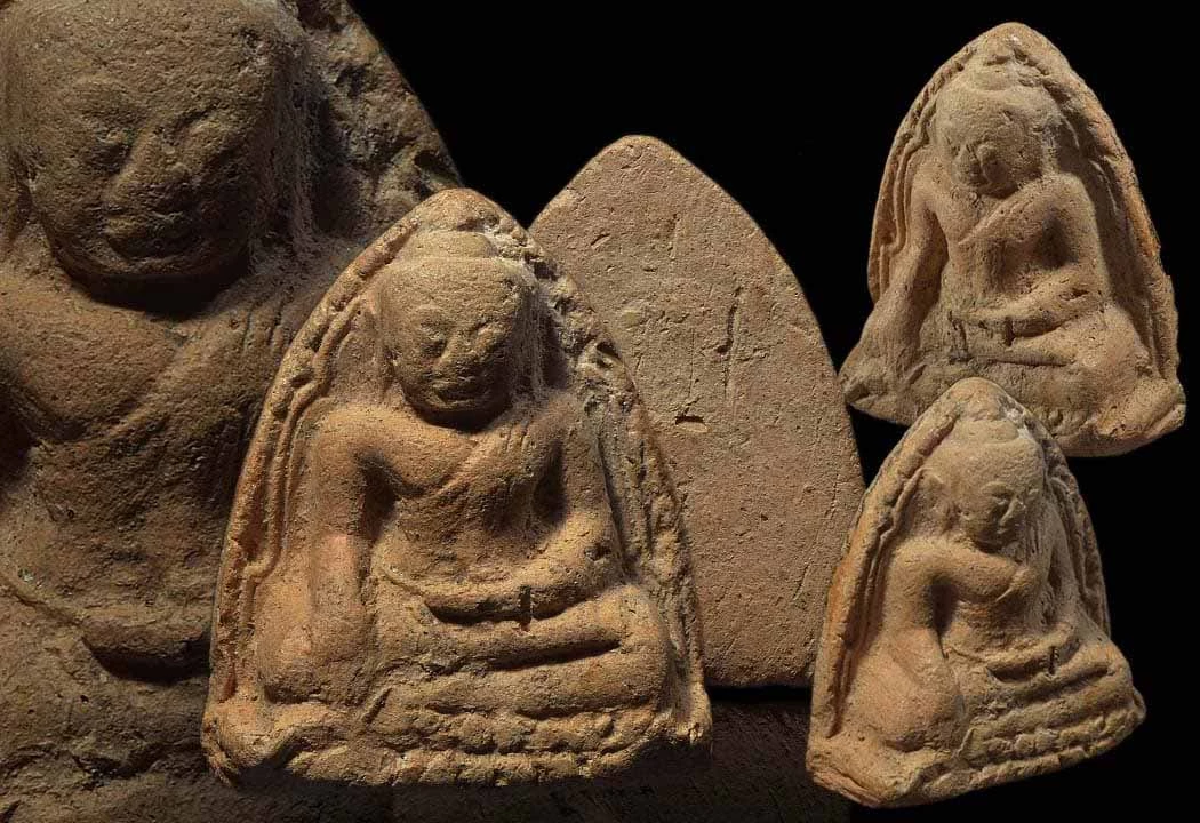
The “Phra Luang Pho To” amulet from Wat Bang Krathing is a highly revered object, particularly among ancient warriors who believed in its protective powers. This amulet, made from Ayutthaya clay, is known for its distinctive characteristics and age, over 400 years old, reflecting the artistry of Ayutthaya craftsmen.

The discovery of the “Phra Luang Pho To” amulets is not thoroughly documented, but a significant excavation occurred in BE 2481 during the renovation of the old temple hall. Workers found these amulets beneath the principal Buddha statue. Some were distributed to the local community as a token of appreciation for their contributions to building the new hall, while the rest were reinterred beneath the new statue.

The Rediscovery and Preservation of the Amulets

During the excavation, original molds of the “Phra Luang Pho To” amulets were also found. Unfortunately, some amulets and molds were later stolen. To prevent further thefts, the temple conducted another official excavation, uncovering additional amulets. However, these were later determined by the Fine Arts Department to be of a later period, from the Rattanakosin era, due to differences in materials and age compared to the earlier finds.

Characteristics of “Phra Luang Pho To Amulets

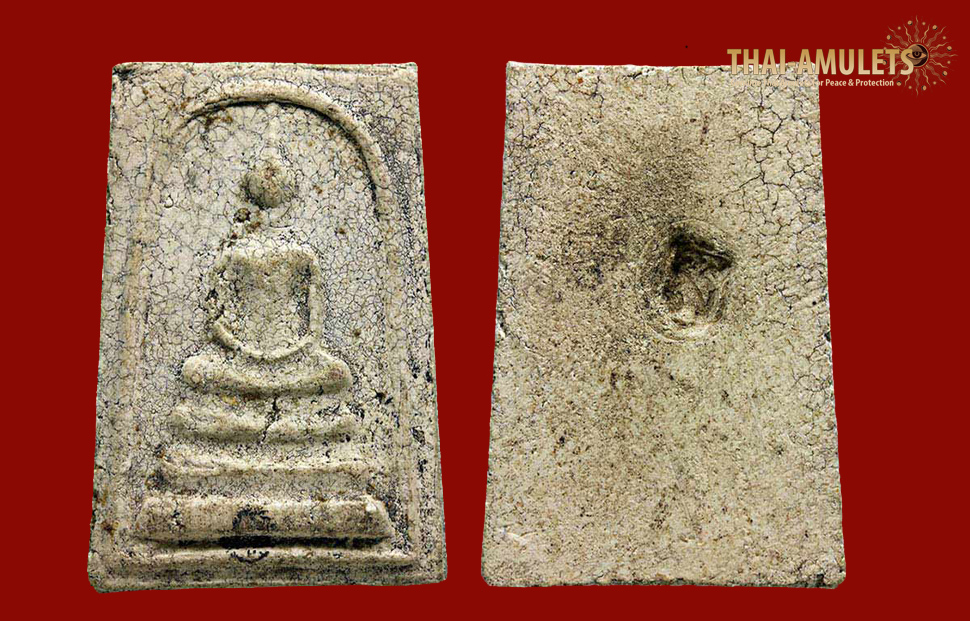
These amulets typically feature a triangular shape with the Buddha seated in meditation (Samadhi) or in the victory over Mara (Maravijaya) posture on a lotus base. The detailed craftsmanship includes prominent facial features and clearly defined robes, with the back often showing distinctive marks known as “betel nut sheath marks.”

“Phra Luang Pho To” amulets are historically significant and highly regarded for their reputed invincibility and protection, believed to render the wearer immune to weapons. Modern collectors also affirm the amulets’ efficacy in attracting favor and goodwill.

The “Phra Luang Pho To” amulet from Wat Bang Krathing remains a treasured piece of Ayutthaya heritage, cherished for its spiritual potency and historical value. Both ancient warriors and contemporary enthusiasts continue to seek these amulets for their renowned protective and benevolent properties.

Pra Kru Chanasongkram
Tiger General – Right Hand Man to Two Kings – Chaophraya Surasse / Maha Sura Singhanat
พระกรุวัดชนะสงคราม

History has sometimes overlooked Chaophraya Surasee’s contribution to the building of the New Siam perhaps because he was devoted to his older brother, Rama I, and the collective ideals of creating a new order in Siam.

From 1767-1782 during the Kingdom of Thonburi, Boonma fought along and served King Taaksin in at least 13 battles against internal competitors and external enemies.

After the death of King Taaksin in 1782 and the enthronement of General (Chaophraya) Chakri as King Rama I, General Surasee was honored and elevated by his brother, the new king. He was appointed Uparaja or Second King (in modern terminology this would be Deputy King or Crown Prince) and continued to serve as an able and imaginative Supreme Commander. An aggressive leadership style, where Forward was his most common command, earning him the nickname Phraya Seua or The Tiger General from soldiers in the field.

chaophraya surasi

Perhaps the Tiger Generals most illustrious battle was in 1785, at Laadya, Kanchanaburi, three years after King Bodawpaya of Burma took over the throne when he led 30,000 Siamese troops against a formidable Burmese force of 90,000. Strategy, again, by moving swiftly, and with surprise, Uparaja Chaophraya Surasee prevented the Burmese settling in and picking their own battle position. A lack of iron cannon balls didn’t deter the Tiger General who quickly ordered balls of hardwood to be fired causing much havoc as they rained down on Burmese foot-soldiers and cavalry.

This was the first war between Burmese and Siam during the reign of King Rama I and known as The War of Nine Armies

Uparaja Chaophraya Surasee, as Deputy King and Supreme Commander, died in 1803 aged 60 years. It is fitting to recall that his last battle, at the age of 59, was ousting the Burmese from the northern city of Chiangmai.A statue of the Tiger General, who gave loyal service to two great Siamese kings, was unveiled by His Majesty King Bhumibol in 1979. It is situated at Wat Mahathat (Bangkok) and depicts a soldier, standing tall, with a sword in each hand. This is The Tiger General!

Wat Chanasongkram – Sacred Kru

The Kru (cell of sacred amulets) discovered at Wat Chanasongkram was originally created by HRH Prince Maha Surasee, (The Tiger General), royal brother of King Rama I the Great during the first period of the Chakri dynasty.

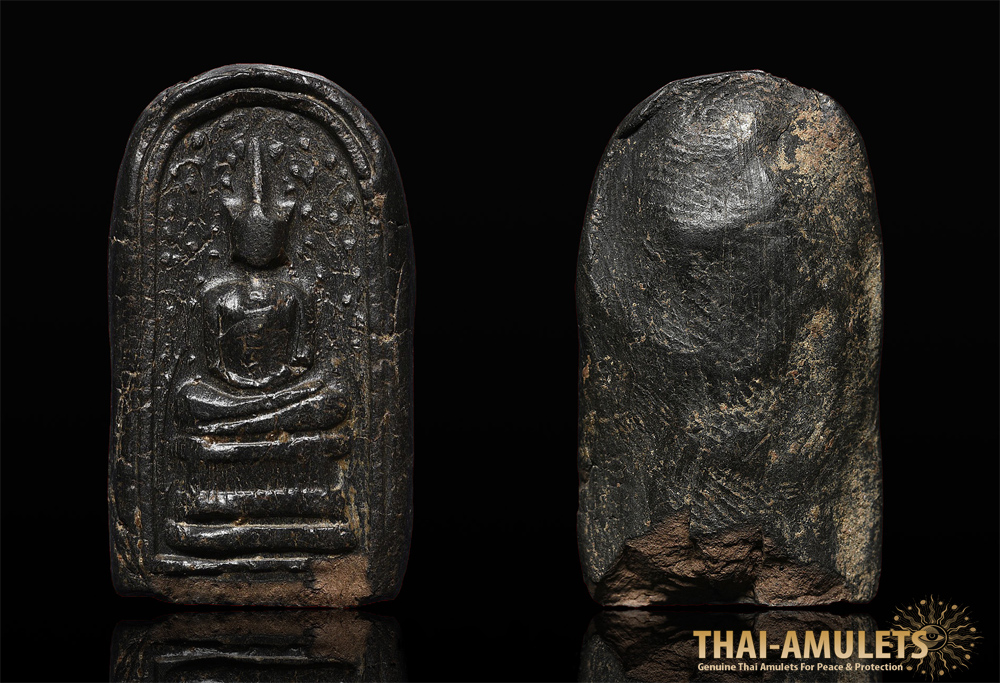
These amulets were created around 200 years ago and retained in a Kru located inside a chedi. They were re-discovered in B.E.2495, when the Abbot, Jaokun Pradharmpitok relocated the chedi to make room for a new school. The Abbot decided to give these amulets away to all the donors who had supported the construction of the new school and other renovation projects within the temple.Originally these amulets were quite fragile and were easily broken, as they were made from unbaked soil and Bailarn leaves. Jaokun Pradharmpitok decided to preserve the amulets by baking them.

Pims

There were many different Pims (styles) found in the Kru including Pim Prokbhoti, Pim Soomtaowanlui, Pim Kang Yun, Pim Pidta, etc. It was said that a policeman who was shot was wearing one of these amulets miraculously escaped un-injured. As a result, the fame of these amulets increased substantially


There are so many good somdej amulets blessed by Luang Phor Tim that can be purchased on a budget. It is a misconception that genuine amulets blessed by LP Tim are expensive, and this top quality pim is one very good example.

Known as pim Somdej Kai Adisorn, which takes its name after a  famous Thai military regiment from Saraburi Province. The amulet was originally created to raise funds to construct a hospital, now known as Adisorn Hospital.

Many sacred famous monks participated in the blessing ceremony in BE 2514 including Luang Phor Tim, Wat Lahanrai A ceremony was held on the 16th January BE 2514 to create these pims which comprise of many auspicious components collected from temples throughout Thailand including sacred powders from  LP Tim. The batch comprised of four different pims:

Pra Somdej amulets, made of sacred powder
Pra Kring amulets, made of sacred alloys
Pra Nangpaya amulets, made of sacred powder
Pra Serdkonnok amulets, made of sacred alloys

Monks in attendance included:

Somdej Pra Sangkarach Pan of Wat Prachetupon
Luang Poo Tim, Wat Laharnrai
Luang Poo Toh, Wat Praduchimplee
Luang Por Pae, Wat Pikultong
Luang Phor Prom of Wat Chongkae
Luang Poo Kuay, Wat Kositaram
Luang Phor Ngern, Wat Don Yai Hom
Luang Phor Kong, Wat Wangsaparos
Luang Phor Top, Wat Chondan
Luang Por Noi, Wat Dharmsala
Luang Por Tae of Wat Sam Ngam
Luang Phor Kong, Wat Bansuan
Luang Poo Num,Wat Donsala
Luang Phor Mui, Wat Domrai
Luang Poo Cha, Wat Nongparpong
Luang Poo Dul, Wat Buraparam
Luang Por Kasem, Wat Susantriluck
Luang Poo Sam, Wat Trivivek
Luang Poo Fun, Wat Pa Udomsomporn
Luang Poo Sim, Wat Tumpapong
Luang Poo Bang,Wat Nongplub
Luang Poo Nerng, Wat Julamani
Luang Phor Ki, Wat Hoochangi


Phra Pang Perd Lok is a style (Pim or Pang Leela) of Buddha Image, representing his descent from the Tavatimsha Heaven, to which he had risen in order to preach to his mother.

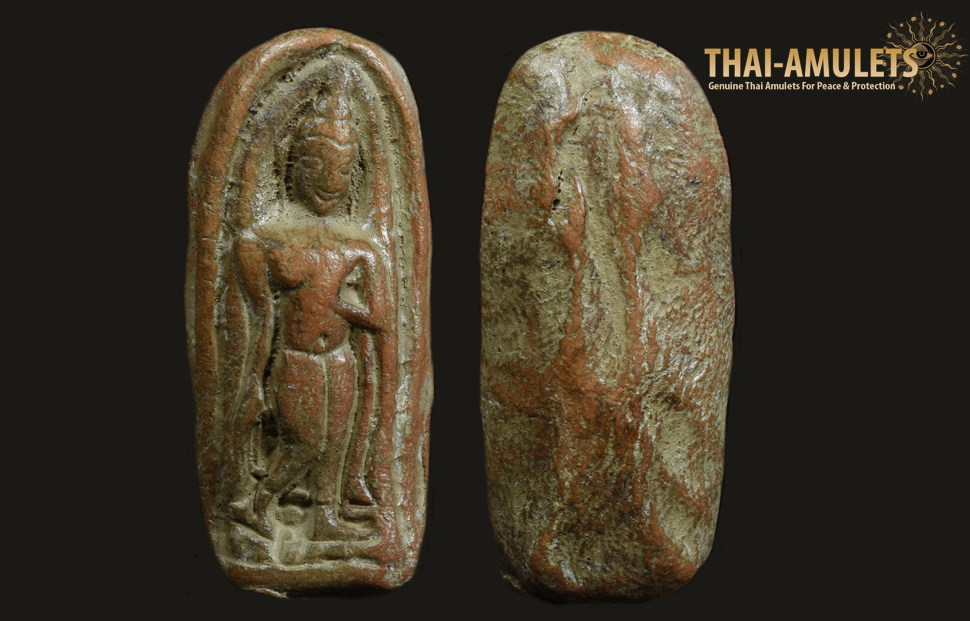
A figure that seems to have come to a momentary pause mid-stride, one heel raised while the other foot is firmly planted on the ground, one hand lifted in a gesture of giving instruction or dispelling fear, while the other arm is naturally at its side.This iconography is most closely associated with amulets from the Sukhothai era and are considered by many collectors to be some of the most beautiful pims ever created.

The Buddha is always represented with certain physical attributes, and in specified dress and specified poses. (Pang) Each pose, and particularly the position and gestures of the Buddha’s hands, has a defined meaning.

The most important aspect of the iconography of the Buddha is gestures made with the hands, known as  mudrā, a symbolic or ritual gesture.

The Abhaya mudrā (“mudrā of no-fear”) represents protection, peace, benevolence, and dispelling of fear. In the Thervada it is usually made with the right hand raised to shoulder height, the arm bent and the palm facing outward with the fingers upright and joined and the left hand hanging down while standing. This mudrā is associated with the walking Buddha.

The gesture was used by the Buddha when attacked by an elephant, subduing it as shown in several frescoes and scripts.The dress of the Buddha is the monastic robe, draped over both shoulders, or with the right shoulder bare.

It was at Sukhothai that the most beautiful and characteristic Thai art developed including the Walking Buddha, the highpoint not only of Sukhothai art, but indeed of Siamese art as a whole.

The Thai adopted Theravada Buddhism from the Mons, and also incorporated their basic conception of image making; the art of Sukhothai is therefore closely linked to the art of Gupta, India. From the Khmer, the Thai retained a deep affection for the great Indian epics, especially the Ramayana.

Although the artists of the Sukhothai period are often credited with ‘inventing’ the walking Buddha, it actually appeared in Indian sculpture (only in relief) much earlier and in particular the Jain sect, an old religion dated around 6 BC.

Walking Buddhas display the gesture of dispelling fear (Abhaya Mudra), or giving instruction (Vitarka Mudra).

The original Pra Pang Perd Lok amulets were heavily influenced by the iconography of the Khmer Kingdom, evidenced by the similarity of the face to various Hindu gods.The Thais re-designed the style and nowadays is called Phra Leela and although essentially the same amulet tends to appear be somewhat more delicate and lively.

Today Phra Leela is respected as one of the most beautiful images of Buddha in the world.

Pra Pang Perd Lok amulets can be classified according to several different style of pim. Although somewhat technical and used only by professionals, I list it here for your reference.

1.Pim Ting Ding (Toes of the Buddha image are close to one another)

2.Pim Teen Tang (Toes of the Buddha image are further apart )

3.Pim Yerntor (Buddha Image standing on a base)

4.Pim Met Tonglarng (Similar in shape to the seed of Tonglarng, a species of Thai plant)

5.Pim Kleep Jumpa (shape of amulets similar to Jumpa, a species of Thai flower)

6.Pim Kleep Bua (Similar in shape to the lotus)

7.Pim Kempetch (Similar in shape to Kempetch, a variety of Thai flower)

8.Pim Bai Kem (shape of amulet similar to the leaf of the Kem flower.

9. Pim Khanun

The smallest Pra Pang Perd Lok amulets are approximately two-centimeter high and the tallest are about eight-centimeter high.

Today the most sought after Leela amulets originate from Kamphaengphet province, often achieving very high prices. Probably the most affordable Sukhothai pims are those from Kru Larn Dokmai.


Luang Phor Boon/ Luang Phor Perm/ Luang Phor Jeua – Wat Klang Bang Kaew

If you are searching for an amulet brimming with sanctity and power, both inside and out, look no further than the amulets of Luang Pu Boon of Wat Klang Bang Kaew, Nakhon Pathom Province. Luang Pu Boon is a renowned monk of the old generation, celebrated in the Nakhon Chai Si River region for his high-level meditative attainments and profound knowledge in various mystical arts and spells. His expertise in these areas is widely acknowledged as unrivaled.

Revered Status Among Contemporary Monks

Due to his exceptional abilities, Luang Pu Boon is ranked among the top venerated monks known for their spiritual prowess and magical disciplines. His strong meditative practices and mystical insights earned him respect and admiration from contemporary monks, including:

  • Somdet Phra Sangharaja (Pae) of Wat Suthat Thepwararam
  • Luang Por Thap of Wat Thong (Wat Suwannaram) in Khlong Bangkok Noi
  • Luang Pu Nak of Wat Huai Chorakhe

These esteemed figures and many others held Luang Pu Boon in high regard, further cementing his legacy as a powerful and respected spiritual teacher.

Luang Pu Boon’s amulets are not only revered for their external craftsmanship but also for the immense spiritual power they possess. Whether you seek protection, blessings, or spiritual guidance, the amulets of Luang Pu Bun are a testament to his unmatched abilities and profound

Generally Luang Phor Boon’s Bia Gae amulets were very similar in design to those of Luang Phor Rod, Wat Nai Rong. Hardly surprising when you consider that Luang Phor Boon was also taught by Luang Phor Khak. It is also recorded that he often visited Luang Phor Rod for instruction.

Therefore it is generally considered that Luang Phor Boon was a student of both sacred monks.

Luang Phor Boon – Bia Gae

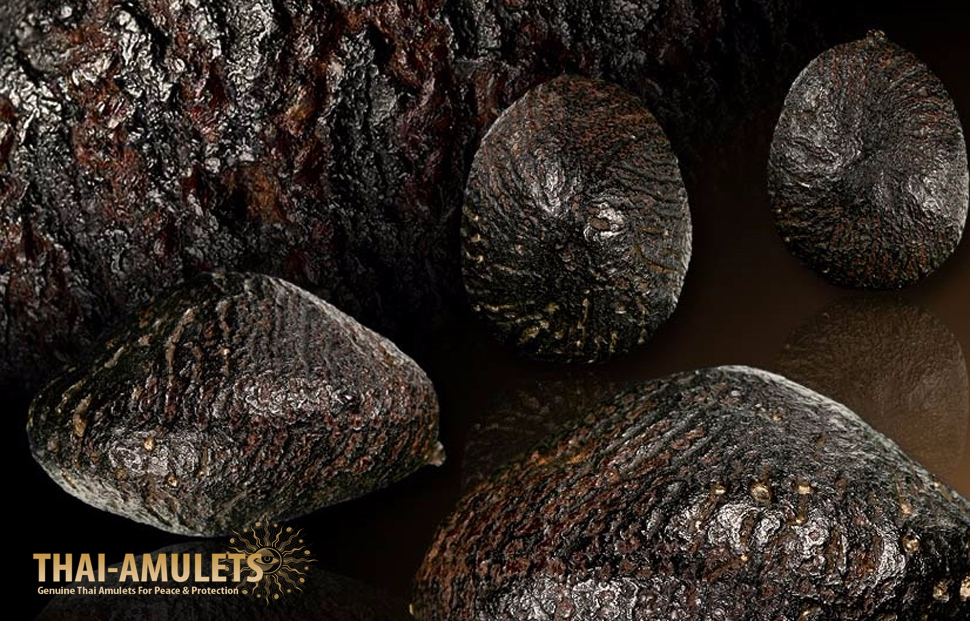
The creation of the “Bia gae” begins with the search for a shell with 32 teeth, as described in ancient texts. Then, the teacher inserts consecrated mercury into the shell and finds a way to seal it in, using ancient vedas. This process requires a highly skilled practioner because it involves using spells to call upon and compel the mercury to merge within the shell.

The mouth of the “Bia Gae,” is sealed with copper / lead plates inscribned with sacred spells. Additionally, there are various types of “Bia Gae”  including those wrapped with knitted ropes adorned with three brass rings for waist fastening .

Regarding the amulets’ use, there are many methods available to ensure protection from various dangers and evils, including black magic spells, enemies, spirits, intoxicants, and poisonous insects.

In terms of relative value, Luang phor Rod’s amulets are slightly more expensive compared to those created by Luang Phor Boon.

Luang Phor Boon was born on July 3, B.E.2391 during the reign of King Rama III. He was the eldest amongst the six children of Mr. Seng and Mrs.Lim.

When he was 13, his father passed away and he was sent to Wat Klang Bangkaew to learn Lord Buddha’s Dharma. He was ordained as a novice at the age of 15 and a monk on the 21st June, BE 2412, aged 20. He resided at the temple his entire life, until he passed away in BE 2478

Luang Phor Boon lineage includes Luang Phor Perm and Luang Phor Jeua, both highly accomplished in their own right